I Built a File System Where Nobody Can Lie to You
2025-10-02 · 13 min read
Here is a question that sounds dumb but isn’t: when someone sends you a file over the network, how do you know it’s the file you asked for? Not “the server pinky-promised.” Actually know.
Normally you don’t. You ask server.com for report.pdf, it hands you some bytes, and you just trust it. If the server swapped the bytes, corrupted them in transit, or got popped last Tuesday, you have no way to tell. You named the file, and the name is a label anybody can slap on anything.
I got a little obsessed with fixing that and built Phile Storage, a peer-to-peer file system in Go where a peer physically cannot hand you tampered data. In this post I’ll walk through the whole thing: the one idea that makes it work, the actual Go code that enforces it, how peers find each other with no server in the middle, and where the design bites back. By the end you’ll be able to build a tiny version yourself.
Here’s the map:
- What content addressing is, and why it changes the trust model
- The ~40 lines of Go that turn bytes into an address
- How a fetch gets verified so lying becomes mathematically impossible
- How peers discover each other over libp2p with zero infrastructure
- The tradeoffs, because there are always tradeoffs
Let’s go.
The core idea: stop naming files, start fingerprinting them
The whole system rests on one move called content addressing, and it’s a genuine vibe shift. Instead of addressing a file by a name you chose, you address it by the hash of its actual bytes. The address is the fingerprint.
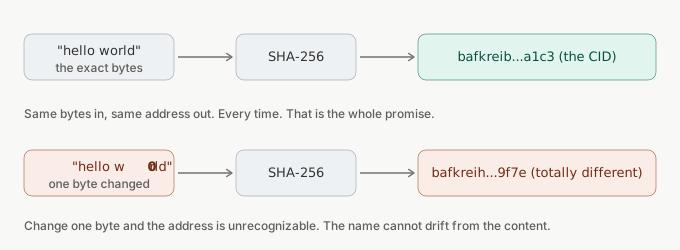
In Phile that fingerprint is a CID (content identifier). The rules for making one are fixed up front: CID version 1, a codec that says “these are just raw bytes,” and SHA-256 as the hash.
// rawCodec marks a CID as pointing at opaque bytes (not a DAG node).
const rawCodec = 0x55

var prefix = cid.Prefix{
    Version:  1,
    Codec:    rawCodec,
    MhType:   mh.SHA2_256,
    MhLength: -1,
}

// Compute returns the CID for a block of bytes.
func Compute(data []byte) (cid.Cid, error) {
    return prefix.Sum(data)
}
↗ backend/internal/content/cid.go
Feed in bytes, get back a CID. Same bytes always produce the same CID. Change one pixel, one comma, one byte, and you get a completely different CID. The name and the content are now welded together. You cannot pry them apart.
This one decision buys you three things basically for free:
- Dedup. Two people upload the identical file? Same bytes, same CID, stored once. You didn’t write any “check for duplicates” logic. The math just does it.
- Immutability. A CID points at exactly one possible set of bytes, forever. There is no “update the file at this address.” A different file is a different address, full stop.
- Verification. And this is the good one. Keep reading.
The part where lying becomes impossible
Here’s the magic trick. If the address is the hash of the content, then anyone who receives content can just re-hash it and check it matches the address they asked for. Two tiny functions do this:
// Verify reports whether data hashes to want.
func Verify(data []byte, want cid.Cid) bool {
    got, err := Compute(data)
    if err != nil {
        return false
    }
    return got.Equals(want)
}
↗ backend/internal/content/cid.go
Now watch where that gets used. When a Phile node fetches a block from some random peer across the network, the very last thing it does before returning the bytes is verify them:
// Fetch pulls a block from a provider over a stream and returns it only if the
// bytes hash to c. Wrong or tampered content is rejected, never returned.
func (n *Node) Fetch(ctx context.Context, c cid.Cid, from peer.AddrInfo) ([]byte, error) {
    // ... connect, open the stream, send the CID we want ...

    data, err := io.ReadAll(s)
    if err != nil {
        return nil, fmt.Errorf("read block: %w", err)
    }
    if !content.Verify(data, c) {
        return nil, fmt.Errorf("integrity check failed for %s", c)
    }
    return data, nil
}
↗ backend/internal/p2p/fetch.go
Think about what that if statement actually means for an attacker.
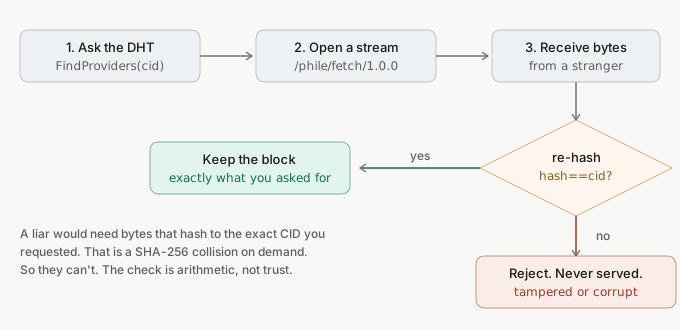
A malicious peer wants to feed you garbage. But you asked for CID bafkreib...a1c3. For your check to pass, the garbage they send would have to hash to bafkreib...a1c3. That’s the same as asking them to find a SHA-256 collision on demand, which, lol, no. So they can’t. Corrupted or swapped content just gets rejected on arrival, automatically. Trust isn’t a feeling here. It’s arithmetic.
Okay but how does it find the file at all?
Cool, the bytes are verifiable. But there’s no central server. So when I ask for a CID, who do I even talk to? This is where libp2p does the heavy lifting.
Every node has a PeerID, and it’s worth being precise about what that is, because it’s the same trick as content addressing pointed at identity instead of data. On first boot, loadOrCreateIdentity generates an Ed25519 keypair, marshals the private key, and writes it to identity.key with 0600 permissions (owner-only). The PeerID is derived from the public key. That makes it self-certifying: you cannot claim a PeerID you don’t hold the private key for, the same way you can’t SSH in as someone whose key you don’t have. Content addressing says “the address is the hash of the bytes”; PeerIDs say “the address is the hash of your public key.” Same idea, and it’s why nobody can impersonate your node just by copying its ID.
priv, _, err := crypto.GenerateEd25519Key(rand.Reader)
// ... marshal and persist to identity.key at 0600 ...
↗ backend/internal/p2p/host.go
Your node is the same “person” every time it boots. Nodes find each other two ways:
- mDNS for peers on your local network. The “shout on the LAN and see who answers” approach.
- A Kademlia DHT for the wider network. A DHT is a distributed phone book with no owner. When my node stores a block, it announces to the DHT “hey, I have this CID,” and anyone can later ask the DHT who has it.
Two setup details matter. The node joins the DHT in ModeServer, which means it doesn’t just query the phone book, it is part of it: it stores routing records for other peers. And the initial Bootstrap call is non-fatal (a failure logs a warning and keeps going), so a node with no reachable bootstrap peers still comes up and can find neighbors over mDNS on the LAN. The mDNS side is aggressive on purpose: when it hears another peer announce itself, it immediately dials them with a 10-second timeout, so the DHT always has someone to talk to without any public bootstrap list. That’s what makes the localhost demo work with zero configuration.
The announce and lookup are two small methods:
// Provide announces to the DHT that this node holds c.
func (n *Node) Provide(ctx context.Context, c cid.Cid) error {
    if err := n.dht.Provide(ctx, c, true); err != nil {
        return fmt.Errorf("provide %s: %w", c, err)
    }
    return nil
}

// FindProviders asks the network who holds c, returning up to max providers.
func (n *Node) FindProviders(ctx context.Context, c cid.Cid, max int) []peer.AddrInfo {
    out := make([]peer.AddrInfo, 0, max)
    for pi := range n.dht.FindProvidersAsync(ctx, c, max) {
        if pi.ID == n.host.ID() { // skip myself
            continue
        }
        out = append(out, pi)
    }
    return out
}
↗ backend/internal/p2p/fetch.go
To download, I ask the DHT FindProviders for a CID, it points me at peers holding it, and I open a direct stream to one of them over a little custom protocol I named /phile/fetch/1.0.0. The wire format is about as simple as it gets: the client writes the CID it wants followed by a newline, then calls CloseWrite() to half-close the stream (a way of saying “I’m done talking, now I’m only listening”), and the server streams the raw block bytes straight back.
Here’s the detail that took me a second to appreciate. The server serves blindly. Look at the stream handler: it reads a CID string, hands it to a provide callback, and writes back whatever bytes come out. It does no verification of its own, and it doesn’t need to, because a lying server gains nothing. All the security lives on the receiving end, in that one content.Verify call. This is the inversion that makes peer-to-peer safe: you don’t need honest servers, you need an honest hash function. The provider could be actively malicious and the worst it can do is waste your bandwidth, because bytes that don’t hash to the CID you asked for hit the floor before they’re ever returned or persisted.
n.host.SetStreamHandler(fetchProtocol, func(s network.Stream) {
    cidStr, _ := bufio.NewReader(s).ReadString('\n')
    data, err := provide(strings.TrimSpace(cidStr)) // serve it, no questions asked
    if err != nil { return }
    s.Write(data)
})
↗ backend/internal/p2p/fetch.go
There’s a matching helper on the client side, ComputeReader, that drains a reader and returns both the bytes and their CID together, precisely so code fetching from an untrusted source can hash first and persist second, never the other way around.
Run it yourself
The fun part: the whole thing runs with zero external infrastructure by default. No database to babysit, no S3 bill, no central index.
git clone https://github.com/Vandit1604/phile-storage
cd phile-storage/backend
make build
./bin/phile-storage -peers=3   # spins up 3 peers on localhost
Upload a file to peer 1, then fetch it by CID from peer 3. It was never copied directly between them by you. Peer 3 asked the DHT, found peer 1, streamed the block, and verified it. Blocks live on disk under blocks/<cid> and get re-announced to the DHT on startup, so a node can reboot and rejoin the network right where it left off.
There’s an optional centralized mode (etcd + Redis) behind a single env var, for when you actually want one global searchable index. But the version that made me build this needs nothing but the peers themselves.
The bonus nobody advertises: it also kills path traversal
Here’s a security win that falls out of content addressing for free, and I didn’t plan for it. Phile stores every block on disk in a file named by its CID: data/<peerID>/blocks/<cid>. Now think about the classic file-server vulnerability, path traversal, where an attacker asks for ../../etc/passwd or ../../../secrets and a naive server happily reads or writes outside its sandbox because it built a path from an attacker-controlled string.
Phile can’t do that, and not because I wrote careful sanitization. A CID is a fixed-alphabet, self-describing string. It comes out of a base-encoding of a hash. It physically cannot contain / or .., because those characters aren’t in the alphabet, and a malformed CID fails to parse in Parse long before it’s ever used as a path segment. So the filename is never really attacker-controlled free text, even though it looks like it came from the network. The same property that makes content addressing verifiable, “the name is a constrained function of the bytes,” also makes it path-traversal-proof. Two security bugs, one design decision.
func (fs *FileStore) blockPath(c cid.Cid) string {
    return filepath.Join(fs.basePath, fs.peerID, "blocks", c.String())
}
↗ backend/internal/storage/filestore.go
And because the filename is the content’s fingerprint, SaveBlock writing the same CID twice is a literal no-op: the bytes are identical by definition, so dedup isn’t a feature you implement, it’s a thing you can’t avoid. At startup, ListBlockCIDs walks that blocks directory and re-announces every CID it finds to the DHT, which is how a node reboots and rejoins the network already advertising everything it holds.
Where the design bites back
I’m not going to pretend content addressing is free lunch. The honest tradeoffs:
- Immutability cuts both ways. “The file at this address can never change” is a feature until you want to change the file. Now you need a mutable pointer that says “the latest version is this CID,” which is a whole separate naming problem (IPFS solves it with IPNS, and it’s the gnarly part).
- Content addressing doesn’t give you discovery. A CID tells you nothing about what the file is. You still need some human-readable name to CID map somewhere, and in decentralized mode each node only knows the names of files it uploaded.
- The DHT is eventually-consistent and can be slow.
FindProvidersmight take a beat, or briefly return nobody if an announce hasn’t propagated. Great for resilience, occasionally annoying for latency. - Connectivity across real NATs is a separate hard problem. The host listens on a plain
/ip4/0.0.0.0/tcp/<port>and nothing else. On localhost or a LAN that’s fine, which is exactly the demo. Between two home networks, both peers sit behind NATs and neither can dial the other without hole-punching or a relay, which real libp2p deployments enable explicitly (EnableHolePunching, circuit relays, public bootstrap nodes) and this one doesn’t. The verification model is planet-scale; the transport config is localhost-scale. Worth being honest that those are different milestones.
TL;DR
- Address files by the hash of their bytes (a CID), not by a name. Name and content become inseparable.
- You get dedup and immutability for free, and every download is re-hashed and verified, so tampered bytes are auto-rejected. Lying is mathematically off the table.
- Trust lives entirely on the receiver. The serving peer sends bytes blindly; the one
content.Verifyon the client side is the whole security model. You don’t need honest servers, you need an honest hash. - Self-certifying identity: a PeerID is derived from an Ed25519 public key, so nobody can impersonate your node by copying its ID. Same trick as content addressing, aimed at identity.
- Path traversal is impossible by construction: a CID can’t contain
/or.., so the on-disk block name is never really attacker-controlled. One design decision, two classes of bug gone. - libp2p handles identity (PeerID), discovery (mDNS + Kademlia DHT in server mode), and a direct fetch stream over
/phile/fetch/1.0.0. No central server. - The catches: immutability makes updates hard, integrity is not availability, and cross-NAT connectivity needs hole-punching this demo doesn’t configure.
Content addressing flips the trust model. You stop trusting who sent the data and start trusting the data itself. Once that clicks, plain old “here’s a file at this URL, trust me bro” starts to feel kind of medieval.
Go deeper
- The Phile Storage repo: github.com/Vandit1604/phile-storage (the CID logic is ~40 lines)
- libp2p docs and the Kademlia DHT spec
- How IPFS works, which uses this exact model at planet scale
- The CID spec if you want to see what’s really inside that string